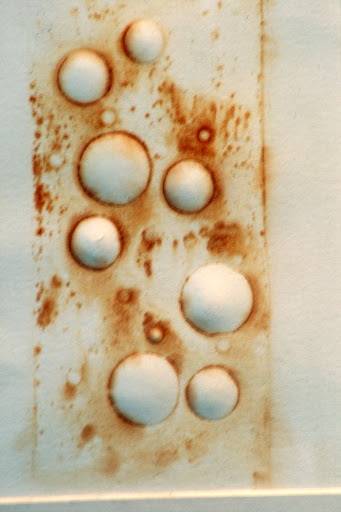
Group Seven collaborative show at Whitespace Gallery. The burns on this mammoth-sized abstract indicate some seriously intense heat. (Photos by Ben Grad. You can view a larger selection at Ben's Picasa site here.)
Group Seven is the local branch of
The Imagillaboration Project, a nationwide network of sculptors collaborating through the
exquisite corpse method first championed by André Breton and other French Surrealists.
The premise is simple: each sculptor creates a "seed," which, as it rotates between artists, evolves in a process of growth, dissection, and reassembly. Although some variations of the game are "blind," each participant here must consciously react to the additions made by the previous artist.
Here's an example by Group Six, a peer group based in Ohio and Michigan.
Rather than a traditional, single-perspective review, I thought it would be appropriate to respond
as a collective. In the spirit of the exquisite corpse, I'm joined by fellow bloggers:
Susannah Darrow (Il Faut Cultiver Notre Jardin)
and
Ben Grad (Proclaim It Lost)
The discussion below follows a similarly themed format; each writer picks one sculpture and begins a description, an inspirational "seed," to be continued by the other two.
 Julia's Seed, collaborative sculpture.Ben:
 An
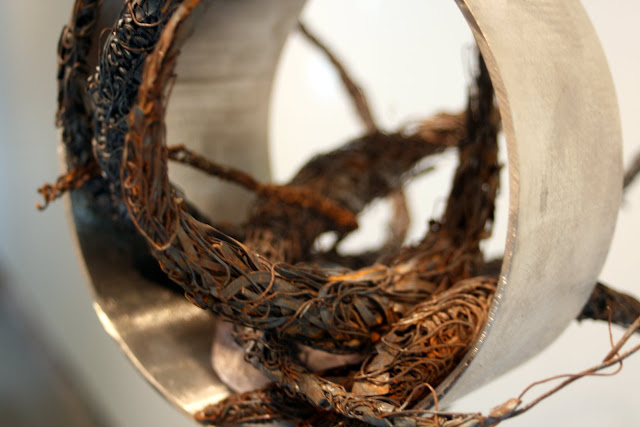
iron filing bezoar perches atop an etched limestone pillar, itself balanced between the four legs of something like an inverted stool. There's an urge to describe the individual components of these structures—to ascribe an artist to each favorite material, structural element, or technique.
Susannah: In this desire to connect each material with a personalized identity, Group Seven’s exquisite corpse has proven itself quite successful. A personification of each artist can be seen in every scrap and oddity. Though this individualism within the sculpture has far from compromised the overall unity of the piece.
Every rusted leg compliments the
smoother, polished sphere that crowns the sculpture. The dreadlock-like tendrils mirror back at the rusted supports. No material is unconsidered and no placement arbitrary.
Jeremy: Although it might be interesting to play detective and link each component to a specific “author,” it would be a little exhausting. I’d rather not distract myself from appreciating the piece as a complete experience. With that said, I do see a kind of vague individualism. Although that sliver of wood—
jutting like a slice of carrot alongside the central limestone column—is a very minor addition, it adds a bit of unexpected contrast. Compared to the outright eclecticism of
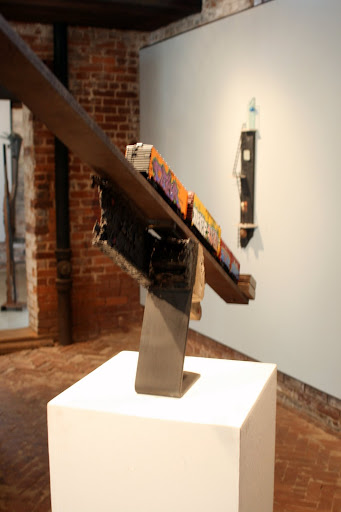
Patrick’s Seed,
Julia’s Seed achieves a very tasteful moderation between anonymous experimentation and editorial control. While I love
Patrick’s Seed, with its little train cars and graffiti, there’s a greater cohesion here between each part.
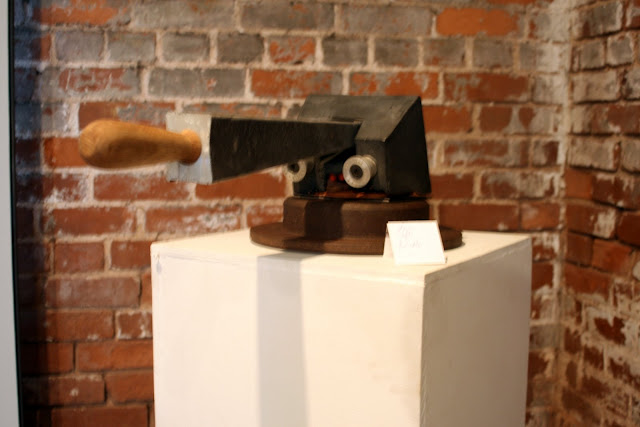
 Matt's Seed, a kinetic, collaborative sculpture. If you can find images no. 17 and 18, you can create your own "animation" by clicking back and forth. Susannah:
 There is a temptation to describe this work in the same sentiment as one would discuss items with a sense of childhood nostalgia. Each element of the sculpture has been worn-in considerably from playmate to playmate and assigned roles previously unimagined.
Jeremy: Nostalgia, perhaps… for sandbox games? I’m reminded of twig bridges over moats guarding towers of cold, red clay. Playing in dirt was always much more personal and interactive than pushing paper as an adult. Of course, sound effects were also important back then. I can almost hear this “mouse trap”
growl and
chomp and salivate (
bluurrahhg!) for more. Its “mouth”
is lined with ear plugs—which, as you pull the handle down—graze against a sculpted ear, perhaps allowing the monster to
hear itself tasting itself.
Ben: Fetishes of “childhood nostalgia”… It's a fun image, but I find myself a bit left behind on this sculptural nostalgia train. This piece
still has a core form, unlike
Kate's Seed (below), which is a different sculpture each time its angle of orbit is shifted. In the hierarchy of nostalgia,
Kate's Seed is Play-Doh, while
Matt's Seed occupies the same position as action figures or three-wheeled bicycles.
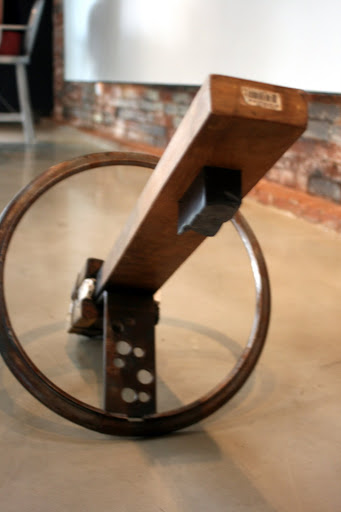
 Kate's Seed, another kinetic collaboration. All three:
 The kinetic sculpture humbly awaits human hands to send
it rolling
it into “orbit.” The materials list (bicycle wheels,
a banana seat, iron,
a kick stand, slate, bronze) is an archeology of omission.
1Layers of editing have reduced what would have been
any cyclist’s
wet iron dream into an earthbound satellite, circumscribed by the chakram of Zena, Warrior Princess
… …translated into a A 2D companion piece
, overlooks the fallen sculpture: bubbles of paper are surrounded by faint halos of rust—
a copy of cut-out circle patterns on the satellite's inner connecting arm. A bar code sticker peels off the end of the 2x4 which stabs through Kate's Seed. Is that bar code yet another satellite? Should we be talking about the human condition now?
Let's skip all that babble. It's a stretch to describe Kate's Seed as a “wheel-within-a-wheel” nesting doll depiction of humanity. Instead, we should be sticking with what's both apparent and obviously intentioned in this piece: kinetics, in all senses of the word.
Every instance of positive and negative space within the sculpture describes anterior movements by its creators. The rust-embossed paper bubbles on a nearby wall seem to exist—by some fate—in parallel with the Swiss-cheese holes in the metal below. The remnants of age and destruction on the charred wood and the decrepit metals speak to past interactions unseen by the viewer. The wheel becomes both a demarcation for each part, intended to function within its boundaries, as well as the portal for transporting the sculpture outside of its allotted space. The transformation of each element in the structure allows Kate’s Seed
to function more effectively than many of the other pieces. In such a minimal sculpture, the suggestion of outside forces leaves the viewer wanting to see the banana seat and the kick stand that have stayed behind the scenes.---
1 The text formatting above indicates each writer's "voice": Jeremy = plain text,
Ben = underlined, and
Susannah = italics
For my seed, I invited the other writers to delete, destroy, and edit the entry that came before. Although words can't replicate the effect of wood and metal, I hoped the overlapping text would approximate the collision of different sculptural styles and materials.---
Group Seven closes this Saturday, Aug. 30,
with a special artist talk,
2PM, Whitespace Gallery.
 Companion piece to Kate's Seed. The contours here are an actual impression of the sculpture (click for detail here).
 ***

 Review|Deanna Sirlin: Everything is Optional


 I'm in the second column. Toward the middle. ::: )
 Photo by Michelle Elmore, who owns a new gallery in New Orleans. A friend once suggested that gold teeth were a symbol of the city, and, curious, Elmore decided to find as many as she could. Luv that facial hair...