Showing posts with label experiment. Show all posts

Tuesday, August 26, 2008

Archeology of Omission

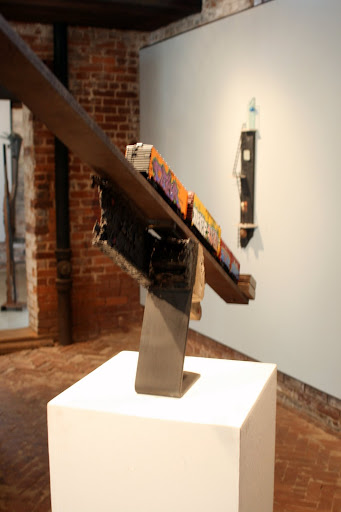
Group Seven collaborative show at Whitespace Gallery. The burns on this mammoth-sized abstract indicate some seriously intense heat. (Photos by Ben Grad. You can view a larger selection at Ben's Picasa site here.)

Group Seven is the local branch of The Imagillaboration Project, a nationwide network of sculptors collaborating through the exquisite corpse method first championed by André Breton and other French Surrealists.

The premise is simple: each sculptor creates a "seed," which, as it rotates between artists, evolves in a process of growth, dissection, and reassembly. Although some variations of the game are "blind," each participant here must consciously react to the additions made by the previous artist. Here's an example by Group Six, a peer group based in Ohio and Michigan.

Rather than a traditional, single-perspective review, I thought it would be appropriate to respond as a collective. In the spirit of the exquisite corpse, I'm joined by fellow bloggers:
Susannah Darrow (Il Faut Cultiver Notre Jardin)

and

Ben Grad (Proclaim It Lost)
The discussion below follows a similarly themed format; each writer picks one sculpture and begins a description, an inspirational "seed," to be continued by the other two.

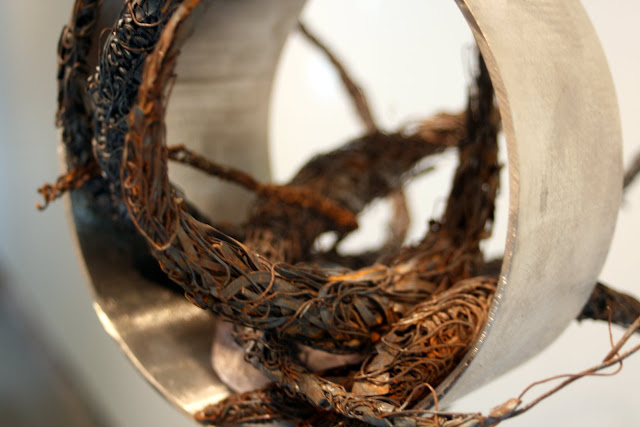
Julia's Seed, collaborative sculpture.

Ben: An iron filing bezoar perches atop an etched limestone pillar, itself balanced between the four legs of something like an inverted stool. There's an urge to describe the individual components of these structures—to ascribe an artist to each favorite material, structural element, or technique.

Susannah: In this desire to connect each material with a personalized identity, Group Seven’s exquisite corpse has proven itself quite successful. A personification of each artist can be seen in every scrap and oddity. Though this individualism within the sculpture has far from compromised the overall unity of the piece. Every rusted leg compliments the smoother, polished sphere that crowns the sculpture. The dreadlock-like tendrils mirror back at the rusted supports. No material is unconsidered and no placement arbitrary.

Jeremy: Although it might be interesting to play detective and link each component to a specific “author,” it would be a little exhausting. I’d rather not distract myself from appreciating the piece as a complete experience. With that said, I do see a kind of vague individualism. Although that sliver of wood—jutting like a slice of carrot alongside the central limestone column—is a very minor addition, it adds a bit of unexpected contrast. Compared to the outright eclecticism of Patrick’s Seed, Julia’s Seed achieves a very tasteful moderation between anonymous experimentation and editorial control. While I love Patrick’s Seed, with its little train cars and graffiti, there’s a greater cohesion here between each part.

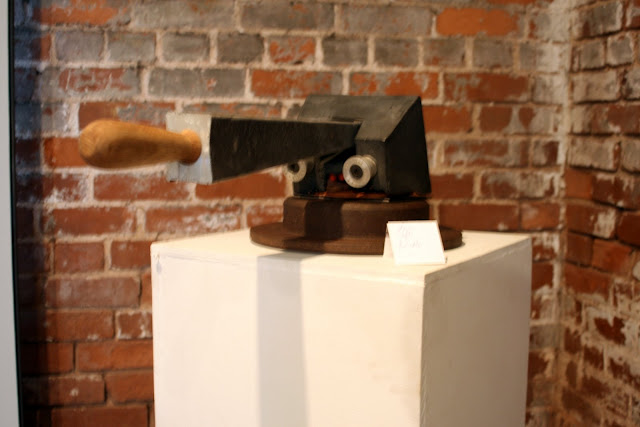
Matt's Seed, a kinetic, collaborative sculpture. If you can find images no. 17 and 18, you can create your own "animation" by clicking back and forth.

Susannah: There is a temptation to describe this work in the same sentiment as one would discuss items with a sense of childhood nostalgia. Each element of the sculpture has been worn-in considerably from playmate to playmate and assigned roles previously unimagined.

Jeremy: Nostalgia, perhaps… for sandbox games? I’m reminded of twig bridges over moats guarding towers of cold, red clay. Playing in dirt was always much more personal and interactive than pushing paper as an adult. Of course, sound effects were also important back then. I can almost hear this “mouse trap” growl and chomp and salivate (bluurrahhg!) for more. Its “mouth” is lined with ear plugs—which, as you pull the handle down—graze against a sculpted ear, perhaps allowing the monster to hear itself tasting itself.

Ben: Fetishes of “childhood nostalgia”… It's a fun image, but I find myself a bit left behind on this sculptural nostalgia train. This piece still has a core form, unlike Kate's Seed (below), which is a different sculpture each time its angle of orbit is shifted. In the hierarchy of nostalgia, Kate's Seed is Play-Doh, while Matt's Seed occupies the same position as action figures or three-wheeled bicycles.

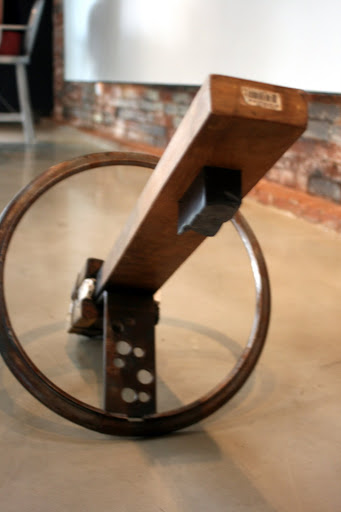
Kate's Seed, another kinetic collaboration.

All three: The kinetic sculpture humbly awaits human hands to send it rolling it into “orbit.” The materials list (bicycle wheels, a banana seat, iron, a kick stand, slate, bronze) is an archeology of omission.1

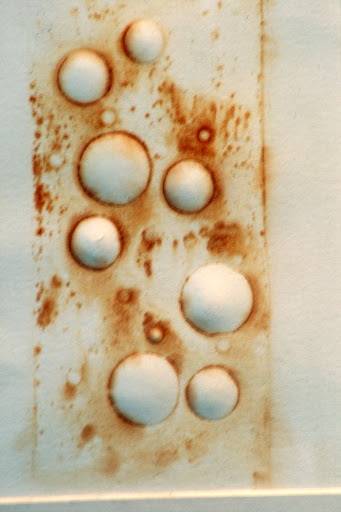
Layers of editing have reduced what would have been any cyclist’s wet iron dream into an earthbound satellite, circumscribed by the chakram of Zena, Warrior Princess… …translated into a A 2D companion piece, overlooks the fallen sculpture: bubbles of paper are surrounded by faint halos of rust—a copy of cut-out circle patterns on the satellite's inner connecting arm. A bar code sticker peels off the end of the 2x4 which stabs through Kate's Seed. Is that bar code yet another satellite? Should we be talking about the human condition now?

Let's skip all that babble. It's a stretch to describe Kate's Seed as a “wheel-within-a-wheel” nesting doll depiction of humanity. Instead, we should be sticking with what's both apparent and obviously intentioned in this piece: kinetics
, in all senses of the word. Every instance of positive and negative space within the sculpture describes anterior movements by its creators. The rust-embossed paper bubbles on a nearby wall seem to exist—by some fate—in parallel with the Swiss-cheese holes in the metal below. The remnants of age and destruction on the charred wood and the decrepit metals speak to past interactions unseen by the viewer. The wheel becomes both a demarcation for each part, intended to function within its boundaries, as well as the portal for transporting the sculpture outside of its allotted space. The transformation of each element in the structure allows Kate’s Seed to function more effectively than many of the other pieces. In such a minimal sculpture, the suggestion of outside forces leaves the viewer wanting to see the banana seat and the kick stand that have stayed behind the scenes.

---
1 The text formatting above indicates each writer's "voice":
Jeremy = plain text,
Ben = underlined, and
Susannah = italics
For my seed, I invited the other writers to delete, destroy, and edit the entry that came before. Although words can't replicate the effect of wood and metal, I hoped the overlapping text would approximate the collision of different sculptural styles and materials.
---

Group Seven closes this Saturday, Aug. 30,
with a special artist talk,
2PM, Whitespace Gallery.


Companion piece to Kate's Seed. The contours here are an actual impression of the sculpture (click for detail here).

***

Monday, August 04, 2008

"Snarky" Bricolage

So I'm back in the land I love: the land of good manners and country-fried cholesterol. I still have photos from Oregon, etc., but, in the meantime, allow me to try something “different.”

From Enemy of the Good, a video by Janet Biggs, visited by both Jonathan Bouknight and Felicia Feaster. In her recently published Art Papers review, Feaster gave the video lower marks than Biggs' other works.

Something about this reminded me of Matthew Barney climbing the walls of the Guggenheim.
- Bouknight, referencing Enemy of the Good.

Like Matthew Barney, Biggs is invested in gender differentiation through costume, sport, and behavior. While both artists are similarly drawn to the fetishistic accoutrements of sports, entertainment, and military culture—the protective padding… has an added vérité spin
- Feaster.
I recently spoke with a friend, a graduate of the GSU philosophy program, about approaches to writing reviews. She described an idea similar to Greg Ulmer's thesis on "post-criticism." What if you wrote the article in a way that actually emulated the the art under review?

Ulmer takes the idea a step further, asking that critics relinquish their role as outside interpreters; basically criticism should reduce itself to the level of collage. The review would become, in words, a montage approximation of the art.
The interest of collage as a device for criticism resides partly in the objectivist impulse of cubism... The cubist collage, by incorporating directly into the work an actual fragment of the referent (open form), remains "representational" while breaking completely [with realism].
Ulmer, "The Object of Post-Criticism," Collected in The Anti-Aesthetic.

Biggs, Solipsism Syndrome.
At first I thought it was a nude hairy male (Biggs purposefully abstracts the bear) which was really interesting, a representation of sexual unrest or the mating dance...
Polar Bears are going extinct you know.

- Bouknight on Solipsism Syndrome.

This juxtaposition of ritualized, controlled performances suggests extreme forms of male strength and female beauty, as well as the human quest for perfection.
- Feaster, referencing the same.

dialectic(s) 1 in ancient Greece, dialectic was a kind of disputation undertaken as a game or exercise in which questions were asked and answers for the most part had to be ‘yes’ or ‘no’.
- The Penguin Dictionary of Philosophy.


Instead of comparing/contrasting two signifiers within one video, such as female swimmers and male military cadets, this video focuses only on the horse and its acrobatic male rider. The relationship between the two is chocked full of innuendos but is not contrived by Biggs... it happens naturally and is more interesting for it.
- Bouknight

The effect of the video works varies. Most are hypnotic and thought-provoking, though Biggs’ Enemy of the Good, 2007 is less successful... Hyperconsious of the camera, the pianist then sits down to perform to an empty concert house. Stagey and performative, the video lacks the naturalism of the other works.
- Feaster.
Everywhere, Killing Time by Marcus Kenney.

I've been hard on Feaster recently, and although I never expected to be taken seriously, I regret my "unqualified" remarks. She is alive—and certainly qualified.
In Kenney’s snarky bricolage, history is something to be discarded or pasted over when necessary. Even his subjects are frighteningly masked and duplicitous, hiding behind black face, hijabs, and appropriated faces...
- Feaster (another review in the July/August issue).

bricolage: French for ‘tinkering about’ or ‘do-it-yourself’; a bricoleur undertakes odd jobs and is a jack-of-all-trades, as distinct from a craftsman. Because of the difficulty of finding a strict equivalent, the French term has been retained by the translators of Levi-Strauss, who uses bricolage to describe a characteristic feature of mythical thought. [The materials of bricolage] are a subset of a wider culture and already have their own meaning, but they can be rearranged in new combinations and contexts.
- The Penguin Dictionary of Critical Theory


These materials become the visual equivalents to the incessant bleating of television news or talk radio—frantic white noise that drowns out any cogent, reasoned thought.
- Feaster.

Farewell to Allusions. There's some ambiguity surrounding the syntax of Kenney's titles. He says the title here is spelled "allusions" not "illusions." This sort of thing must happen all the time...

Marcus Kenney is a homeboy.
- Cinque Hicks, CL, June '08.


Me: Are you... a "homeboy"?
Kenney: I don't know... I'm not sure what a "homeboy" is!
. . .
Kenney: I have to do commentary that includes everything that “American” means. I want to dive in as honest and truthful as I can... So I made a promise to myself to not censor the load. I'm not going to paint what a white 35-year-old male with two kids is supposed to paint. I'm going to paint what I'd paint.
- Notes on Midnight in America ; from a phone conversation.1

dialectic(s) 2 the art of discourse by which we either refute or establish some proposition by means of a question and answer on the part of the interlocutors. This is, for Plato, a method preeminently suited to finding truth, no matter whether the dialogue is carried on with another person or in one’s own mind.

Like the maniacal, violent kinder of Henry Darger, Kenney’s children wield sabers and shields, decapitating other children in frightening echoes of the child armies of Uganda or Sudan.
- Feaster.

Above, signs point in opposing directions, inexplicably, to destinations labeled “here” and “there.” We see here an almost schizophrenic “joy” – shown by the severed head smiling ironically on the floor – expressing a general paroxysm at the dawn of the millennium.
- Continued from my notes.

dialectic(s) 4 Hegel used the term dialectic to designate a process which brings forth an opposition, between a thesis and an antithesis, which has within it an urge to be resolved by a synthesis, a combination in which the conflicting elements are preserved and somehow reconciled.

A row of little girls in camouflage and acid hunter-orange dresses march menacingly toward a boy in State of Nature, 2007, suggesting some imminent attack.
- Feaster.

The same three girls, now in tan camouflage, guard the borderline of some dream-world nation state. The viewer is placed over the shoulder of an anonymous immigrant with skin the color of dishwater... Kenney makes it difficult to take ethical or political positions for or against the subjects presented. The viewer remains in a state of hermeneutic destabilization, unable to find conclusive solutions: What makes this State of Nature so "natural?" What could possibly be "new" about The New Communism?"
- Notes.
Joker Remix, a tribute to the late Heath Ledger by the Atlanta painter, Kombo Chapfika. He finished the painting in 2007—before the actor's death. If you pull up Kombo's site, click on "Portfolio" and find Disco Darfur. It's sick.

Last week, I thought I'd write a post about the latest Batman film. Well—as is commonly the case with blogging—tight scheduling has tossed that idea "down the shitter." Instead, I've given you this "snarky bricolage," which I hope proves more entertaining than pictures of me climbing mountains.

And, as a nice, masochistic chaser, here are some words by Georg W. F. Hegel, philosopher:
Art inspires men to directly opposite emotions, it only magnifies the contradiction of our feelings and passions, and either sets them staggering like Bacchantes, or passes into sophistry and skepticism, in the same way as argumentation.

If culture of the world has fallen into such a contradiction, it becomes the task of philosophy to undo or cancel it, i.e. to show that neither the one alternative in its abstraction nor the other in similar one-sidedness possesses truth, but that they are essentially self-dissolving; that truth only lies in the conciliation and mediation of the two.
- Introductory Lectures on Aesthetics, p. 53 and 60, respectively.
---

1 I later asked Kenney to name some of his favorite music "influences." Public Enemy topped his list, followed by Fat Boys and Easy E...

::: )