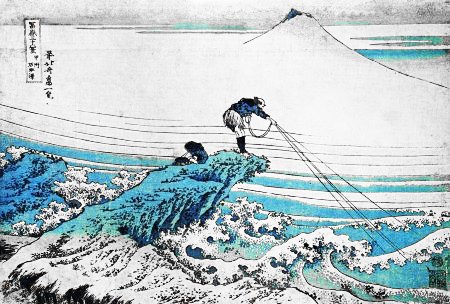
Preemptive Strike by Sam Parker. (Courtesy of Young Blood Gallery. This image is much larger than its thumbnail. Please click?)
I paint a lot of Asian imagery as well as hearts and skulls - classic icons.
- Sam Parker, interview with Pine Magazine, Jan. 2007.
It’s been more than 15 months since that interview, and - in a genuinely good way - it shows.
Parker’s latest series of drawings,
The Road to Excess, feels like a significant leap forward. Although the show is purely monochrome, nothing important was lost with the lack of color. In each of these tightly executed
and highly affordable drawings, Parker compensates with an acrobatic arsenal of imagery.
The clichéd Asian themes are mostly gone. In works like
Preemptive Strike, dragons and
Ukyo wave motifs have been abandoned in favor of pure pop and Mesoamerican myth.
 Preemptive Strike, detail.
You can't see clearly in the detail, but the word balloon contains a quotation from George Orwell's
1984:
"IGNORANCE IS STRENGTH". The phrase forms part of the propaganda mantra that reappears throughout the book:
War is Peace;
Freedom is Slavery;
Ignorance is Strength.
1984 calls these phrases "
doublethink." Doublethink is an authoritarian tool that, by uniting opposing ideas in endless repetition, wipes out our ability to think for ourselves. The distinction between "freedom" and "slavery" loses its meaning. I can't recall any specific examples from our current administration, but I'm sure they exist...
Parker made an interesting choice here: the quotation is given by a fighter pilot. The plane, which
certainly appears American, is decorated with Nazi swastikas and armed with the latest in weapons technology: arrows. Yes - as in "Squanto shoots arrows at the white man" sort of arrows. Although I'm not sure, it appears to be a deliberate appropriation of
Roy Lichtenstein's Whaam! (which was already an appropriation from an
old DC comic...).
So the unicorn at the center (see first image) is locked in the direct crossfire of arrows and a penis-deployed thunder bolt (below). Parker explains that this is how he sees the
propaganda of "The War on Terror." Take Bin Laden for instance. He certainly exists, and many other terrorists - that is, groups of all colors and nationalities - exist around the world. But sometimes it seems like we're on some never-ending search for a mythological beast.
Poor horsey! But who's to blame!? Maybe it was this crazy bastard:
 Skulls and skeletons usually bore me... But not this one. He makes me wanna go sacrifice virgins. To the Sun.
The figure vaguely resembles
Mictlantecuhtli, the Aztec god of the underworld.
But the artist has skillfully hidden his tracks. Parker’s skeletal shaman-king – or, He Who Ejaculates Lightning – doesn’t precisely match any one historical source. Instead, it seems more like an assemblage of Mesoamerican motifs from Aztec, Mayan, and other mythological sources.
1 Usually, it's best to not draw attention to the exact source of your imagery.
Although I'm not qualified to speak in detail, the headdress knots and his seated posture suggest the shaman's status as a traditional Mayan lord. Coupled with his claws and that ridiculous erection, the signs contribute to an overall theme of paternal authority and conquest.
The symbolism also alludes to mystical visions and
ritual bloodletting. Bloodletting, in a way similar to ingested psychedelics, could induce hallucinations - including apparitions of the spirit known as
the Vision Serpent. Incisions were typically made in either the tongue or the penis.
Note the scales and the reptilian fins lining the shaman’s exposed spine. It reminds me of the Indian concept of chakras, the seven energy centers located in the spine.
Kundalini, the flow of enlightened energy, was sometimes represented as a serpent.


Origin of Language (Left)
Too Holy May Not Enter (Right)
Normally, I'd avoid suggesting such remote or mystical influences. But considering the anthropological themes of
The Road to Excess – namely, psychedelic drugs – I think the parallels aren't far off. From that perspective,
Origin of Language is a beautiful statement on the evolution of human civilization. Parker explains that the title was inspired by a lecture by Terence McKenna.
McKenna, an American anthropologist and ecologist, argued that psychedelics were
instrumental in the development of human language. He also considered mushrooms to be a supreme "technology" that could help teach human beings to use their intellect and productive powers for harmony instead of conflict:
We have the technological power, the engineering skills to save our planet, to cure disease, to feed the hungry, to end war; But we lack the intellectual vision, the ability to change our minds. We must decondition ourselves from 10,000 years of bad behavior.
- Terence McKenna, This World...and Its Double. (From the Wiki)
Although the two pieces weren't created as a diptych,
Too Holy May Not Enter was presented side-by-side with
Origin. Together, the collision of mad symbolism and virtuoso, almost calligraphic lines struck me as a strong combination. Drawings like
Too Holy work well because the various forms - the triangle cap (a repeated motif in Parker's series), the pentagon, the black swell of flame, and the robes -
suggest something familiar without solidly committing in any one direction.

 Another gallery shot... Nice layout. : )
 Banner, "Scene 2" - also known as "Signify Nothing."
 Notes from opening night...2 I wonder how many times in my life I'll be scribbling down stuff like "Big Ass Streamer... wolf w/ big titties and erection."
 I actually have very little to say about Parker's banner. Here, the automatism that provided the groundwork for the smaller drawings - a skeleton of
wild circles and slashes that were erased and carefully inked over - has given reign to the play of words. The upside-down message at the top of
"Signify Nothing" reads:
PEOPLE THROW YOUR NAME AROUND AT FANCY ART PARTIES, SIPPING FREE WINE SNACKING ON TINY QUICHES… ‘GUFFAW!!!
It reminds me of
Michi's Eyedrum show; there's something about using art as a chance to "vent" or express the frustration of "struggling to make it" as an artist. What do you guys think?
And then there were the banner's intellectual themes - "Signify nothing" (
semiotics), "Debord died for our subservience" (Situationism), and "We are the simulacra" (
hyperreality, implosion). Although I was glad to see it, the philosophical content served mostly as an extra spice to the main course. It wasn't exactly an "interpretation" of theory, or even an "application." It was more what you'd call a "
rumination" - that is, a visual display of the artist's chewing or digesting of certain ideas.
But as I stated before,
The Road to Excess was a grand improvement overall. The next question, though, is can he pull off this sort of precision... in color?
---
1 Special thanks here to my lovely colleague and Mayan culture enthusiast, Luciana, for help in an area where I have no real expertise...2 Also thanks to Eugie Foster for providing a scanner and general moral support. Eugie's new short story collection will be published sometime next year. ***

 Eudora Welty Suit for My Cat, Toby—part of Linda Hall's show, The Beast in Me, at Young Blood Gallery. Now, just a little closer, dearie…
  We Are What We Endanger. Sorry for the poor photo quality, but you get the idea.