
What I learned in the "real" world (part 1):
1) Middle-aged losers and/or yuppies incessantly ask you, "Oh, a bachelor's degree! So, what are you doing now? Now that you're in the real world, afterall."
Did I mention that these people can all shove it? Shove it right up your bloated, self-important, unimaginative (and retarded) rectal blow-holes.
2) This city is still racist - cotton gin, country club-conspiracy, but keep smiling about it, Johnny - racist.
3) Highschool friends are just as good as any other friends ya' got.
4) Spider Jerusalem rocks. He will annihilate 50,000 metric tons of cityscape in one cascading blitz of his own semen.
Being a bastard pays.
Thursday, August 24, 2006

Sunday, August 20, 2006
Thursday, July 13, 2006

Wednesday, July 05, 2006
Mysteries Decoded (part 1; revised)
This is a revised, nearly-complete version of the essay I posted last month. If you read the last one, just skip down to the second paragraph. I eliminated all quotations and expanded a couple of ideas into distinct sections. It may not sound original, but it is my own labored attempt at re-stating and re-interpreting Barthes' early structuralist thought.
Syntax and clarity... Again, my writing still needs work. Enjoy.
-------------------
Roland Barthes’ essay “The Nautilus and the Drunken Boat” is a wonderful short, critical essay on the work of Jules Verne. The essay is a structuralist analysis of The Mysterious Island, the second and final installment of Captain Nemo’s adventures aboard the Nautilus. With a bit of sarcasm, Barthes calls it an “almost perfect novel,” submitting it as the epitome of a type of childlike delight. Like much of Barthes’ early critical work in the Mythologies, however, the subject of analysis becomes a springing board for a greater critique of modernity. Rather than merely cast judgment on Verne’s credibility as an author, Barthes resuscitates Verne as a symptom of larger cultural epoch.
Syntax and clarity... Again, my writing still needs work. Enjoy.
-------------------
Roland Barthes’ essay “The Nautilus and the Drunken Boat” is a wonderful short, critical essay on the work of Jules Verne. The essay is a structuralist analysis of The Mysterious Island, the second and final installment of Captain Nemo’s adventures aboard the Nautilus. With a bit of sarcasm, Barthes calls it an “almost perfect novel,” submitting it as the epitome of a type of childlike delight. Like much of Barthes’ early critical work in the Mythologies, however, the subject of analysis becomes a springing board for a greater critique of modernity. Rather than merely cast judgment on Verne’s credibility as an author, Barthes resuscitates Verne as a symptom of larger cultural epoch.
The Mysterious
The Nautilus comes to signify an infantile desire for the finite. From this mobile, invincible shell, the reader becomes an accomplice in the imagined project of discovery. Verne proposes to nullify one nature’s most alienating of objects, the ocean. We revel in the disarmament of chaos: the quieting of torrential water, the illumination of impenetrable darkness, the classification of thousands of tons of aquatic vertebrae and flora of every color. The vastness of the ocean becomes increasingly finite. Transmuted into this gem, a map of the Pacific or even a paperback novel, the terror of the deep becomes quaint and deceptively familiar. Like a child playing with blocks, the reader recognizes the ocean as yet another toy for manipulation and exchange. The threat of the unknown is neutralized via cartography, the determined appropriation of each and every hidden crevasse of the earth.
The myth of discovery promises a utopia; it promises a deliverance from chaos. The Nautilus represents the technological impalement of nature. We deliberately emphasize the dual idea of penetration and enclosure. To truly penetrate the mystery of the world, to quell nature with finality, equates to the end of human struggle. It is an impossible task, a completely apocalyptic impulse. In the Nautilus the reader discovers a second womb, a place of complete safety from which we can observe and contemplate the external world.
More specific than any thesis of human nature, the Nautilus characterizes a lingering, yet transformed, Enlightment ideology that quite possibly continues to this day. The mold should be quite familiar still: an insatiable thirst for quick answers, for mysteries solved with theatrical flair and conclusiveness, all wrapped up into a rapidly consumable package.
Emergency Broadcast Network
A coworker introduced me to these video clips last week. EBN was an avant-garde performance group that started in the 90's. They commented on the media, by using the technology and techniques of the media: crazy stuff like hooking up a giganto 50 foot projector and satellite dish apparatus to the top of a van and go driving around daytime traffic screaming into megaphones and shooting rockets at historic landmarks. I think EBN's stuff is great, if a little dated.
Take a look at this music video:
Electronic Behavior Control System
or if that doesn't work, try Joshua L. Pearson's website.
Take a look at this music video:
Electronic Behavior Control System
or if that doesn't work, try Joshua L. Pearson's website.
Friday, June 23, 2006
Captain Midnight!

Captain Midnight was a national radio show that ran for ten whole years in the US. Much of the show's lifespan coincided with WWII (fortunately for the show's sponsors, Skelly Oil Company and then later, Ovaltine). These things are hilarious.
You can listen to EVERY SINGLE EPISODE online.
Fantastic.
Wednesday, June 21, 2006
Tuesday, June 20, 2006

Monday, June 19, 2006
Mysteries Decoded (part 1)
This is the beginning of a series of short essays I've been throwing around in my head for quite some time. I figured that I might as well use this space to exercise my critical eye - especially since the little snippets and quotations I was posting garnered very little feedback. Yes, this is my writing, as derivative as it may be. I'd appreciate any comments whatsoever - on style and content - and keep in mind that this is part of some larger picture:
------------
Roland Barthes’ essay “The Nautilus and the Drunken Boat” is a wonderful short, critical essay on the work of Jules Verne. The essay is a structuralist analysis of The Mysterious Island, the second and final installment of Captain Nemo’s adventures aboard the Nautilus. With a bit of sarcasm, Barthes calls it an “almost perfect novel,” submitting it as the epitome of a type of childlike delight. The most interesting aspect of Barthes’ criticism, however, is the fact that the subject of his essays is never the real topic of discussion. Rather than merely cast judgment on Verne’s credibility as an author, Barthes resuscitates Verne as a symptom of larger cultural epoch.
The Nautilus comes to signify an infantile desire for the finite. He writes:Ships in Jules Verne are perfect cubby-holes, and the vastness of their circumnavigation further increases the bliss of their closure… The Nautilus, in this regard is the most desirable of all caves: the enjoyment of being enclosed reaches its paroxysm when from the bosom of this unbroken inwardness, it is possible to watch, through a large window-pane, the outside vagueness of the waters, and thus define, in a single act, the inside by means of its opposite.
The Nautilus is the ultimate exploration vessel. The ship represents the technological impalement of nature. The threat of the unknown is neutralized via cartography - the determined classification of each and every hidden crevasse of the earth. We emphasize the dual idea of penetration and enclosure with some risk. A knowable universe would indeed constitute a return to the womb, but the intention here is not to diagnose Verne with some sort of private neurosis. More specific than any thesis of human nature, the Nautilus characterizes a lingering, yet transformed, Enlightment ideology that quite possibly continues to this day. The mold should be quite familiar still: an insatiable thirst for quick answers, for mysteries solved with theatrical flair and conclusiveness, all wrapped up into a rapidly consumable package.
Saturday, June 17, 2006
On the Bandwagon
Sharing music? Count me in.
I don't have much to offer, but this guy - Daedelus - I absolutely love. If you like experimental or acid jazz, check this out:
Daedelus - Denies the Day's Demise
Also: Daedelus on MySpace
As noted by my fellow compatriots, I own this CD as well as any other album posted on this page.
Spread the disease. Enjoy.
I don't have much to offer, but this guy - Daedelus - I absolutely love. If you like experimental or acid jazz, check this out:
Daedelus - Denies the Day's Demise
Also: Daedelus on MySpace
As noted by my fellow compatriots, I own this CD as well as any other album posted on this page.
Spread the disease. Enjoy.
Wednesday, May 17, 2006
Nicotine-Be-Gone
School's out; people have lot's of shit on their plate it seems. Death and destruction.
Sorry about your buddy, David: it must feel terrible.
I'm on the Patch now. Chewing gum and chugging bottled water. Sick to my stomach. Insomnia. ...Awesome.
Marie is out-of-town, so I'm trying to keep myself busy and distracted. Reading intensely. Writing and drawing too. Might even have my own artwork to post this summer.
Stay in touch.
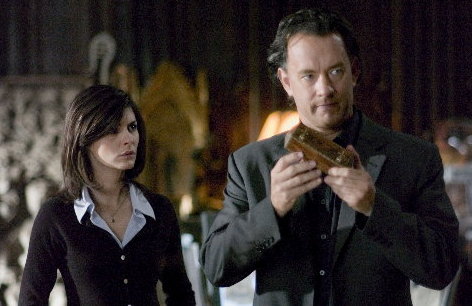
Count the Days: foolish-movie-event of the year

Thursday, May 04, 2006
Pynchon on Sloth
From Thomas Pynchon's "Nearer, My Couch, to Thee," an excellent short history of Sloth
(as in the-seven-deadly entropic-or; the "cathode-anode serenity found in the pure, informationless state of signal zero" . . .) :
Sitting there on some medieval death row, going, "So, look, no offense, but what'd they pop you for anyway?"
"Ah, usual story, they came around at the wrong time of day, I end up taking out half of some sheriff's unit with my two-cubit crossbow, firing three-quarter-inch bolts on auto feed. Anger, I guess.... How about you?"
"Um, well ... it wasn't anger...."
"Ha! Another one of these Sloth cases, right?"
". . fact, it wasn't even me."
"Never is, slugger -- say, look, it's almost time for lunch. You wouldn't happen to be a writer, by any chance?"
In his classical discussion of the subject in the "Summa Theologica," Aquinas termed Sloth, or acedia, one of the seven capital sins. He said he was using "capital" to mean "primary" or "at the head of" because such sins gave rise to others, but there was an additional and darker sense resonating luridly just beneath and not hurting the power of his argument, for the word also meant "deserving of capital punishment." Hence the equivalent term "mortal," as well as the punchier English "deadly."
Philadelphia, by Franklin's time, answered less and less to the religious vision that William Penn had started off with. The city was becoming a kind of high-output machine, materials and labor going in, goods and services coming out, traffic inside flowing briskly about a grid of regular city blocks. The urban mazework of London, leading into ambiguities and indeed evils, was here all rectified, orthogonal. (Dickens, visiting in 1842, remarked, "After walking about in it for an hour or two, I felt that I would have given the world for a crooked street.")
Any discussion of Sloth in the present day is of course incomplete without considering television, with its gifts of paralysis, along with its creature and symbiont, the notorious Couch Potato. Tales spun in idleness find us Tubeside, supine, chiropractic fodder, sucking it all in, re-enacting in reverse the transaction between dream and revenue that brought these colored shadows here to begin with so that we might feed, uncritically, committing the six other deadly sins in parallel, eating too much, envying the celebrated, coveting merchandise, lusting after images, angry at the news, perversely proud of whatever distance we may enjoy between our couches and what appears on the screen.
(as in the-seven-deadly entropic-or; the "cathode-anode serenity found in the pure, informationless state of signal zero" . . .) :
Sitting there on some medieval death row, going, "So, look, no offense, but what'd they pop you for anyway?"
"Ah, usual story, they came around at the wrong time of day, I end up taking out half of some sheriff's unit with my two-cubit crossbow, firing three-quarter-inch bolts on auto feed. Anger, I guess.... How about you?"
"Um, well ... it wasn't anger...."
"Ha! Another one of these Sloth cases, right?"
". . fact, it wasn't even me."
"Never is, slugger -- say, look, it's almost time for lunch. You wouldn't happen to be a writer, by any chance?"
In his classical discussion of the subject in the "Summa Theologica," Aquinas termed Sloth, or acedia, one of the seven capital sins. He said he was using "capital" to mean "primary" or "at the head of" because such sins gave rise to others, but there was an additional and darker sense resonating luridly just beneath and not hurting the power of his argument, for the word also meant "deserving of capital punishment." Hence the equivalent term "mortal," as well as the punchier English "deadly."
Philadelphia, by Franklin's time, answered less and less to the religious vision that William Penn had started off with. The city was becoming a kind of high-output machine, materials and labor going in, goods and services coming out, traffic inside flowing briskly about a grid of regular city blocks. The urban mazework of London, leading into ambiguities and indeed evils, was here all rectified, orthogonal. (Dickens, visiting in 1842, remarked, "After walking about in it for an hour or two, I felt that I would have given the world for a crooked street.")
Any discussion of Sloth in the present day is of course incomplete without considering television, with its gifts of paralysis, along with its creature and symbiont, the notorious Couch Potato. Tales spun in idleness find us Tubeside, supine, chiropractic fodder, sucking it all in, re-enacting in reverse the transaction between dream and revenue that brought these colored shadows here to begin with so that we might feed, uncritically, committing the six other deadly sins in parallel, eating too much, envying the celebrated, coveting merchandise, lusting after images, angry at the news, perversely proud of whatever distance we may enjoy between our couches and what appears on the screen.
Poems from the Machine
Some verse I "created" with the aid of William S Burroughs-Arthur Rimbaud poetry generator.
---------------------
He faces the horizons in the shadowy glade where
A little wild ray of light gods who bit mankind sucked joyfully;
pours burning love the devil's paladins;
like dragonflies threading! when the sap of the world!
Vision of her big breasts the hidden window.
- like an organ of iron, down the long black river.
For these cracked brains dropping pollen like commas.
- nubile and full-blooded through this horror of space.
storm drain lavenderblush flows seagreen coughing sepia rainbow
And faces the horizons, in the shadowy glade where
at her blessed nipple at times she rouses
on their pale vertebrae: organ-pipes;
Nailing them naked to coloured,
i should rudder and anchor,clamouring birds seen archipelagos of and of singing phosphorus
drowned men sank, down into abysses
---------------------
He faces the horizons in the shadowy glade where
A little wild ray of light gods who bit mankind sucked joyfully;
pours burning love the devil's paladins;
like dragonflies threading! when the sap of the world!
basement rent blackberry; kiwi angels faded hypnotized; honeydew candlelight mermaids; darkorchid frosty storm drain
Vision of her big breasts the hidden window.
- like an organ of iron, down the long black river.
For these cracked brains dropping pollen like commas.
- nubile and full-blooded through this horror of space.
storm drain lavenderblush flows seagreen coughing sepia rainbow
And faces the horizons, in the shadowy glade where
at her blessed nipple at times she rouses
on their pale vertebrae: organ-pipes;
Nailing them naked to coloured,
i should rudder and anchor,clamouring birds seen archipelagos of and of singing phosphorus
drowned men sank, down into abysses
Wiki
Lil' Bro, Jon Carll, wrote this little homage biography and posted it on Wikipedia. It should stay there for most of the day. Thanks Jon.
Your continued donations keep Wikipedia running!
Jeremy eugene abernathy
From Wikipedia, the free encyclopedia
Jump to: navigation, search
Humanities student, artist, aesthete and dungeonmaster extraordinaire, Jeremy Eugene Abernathy will have graduated from Oglethorpe Univesity on May 13, 2006 with a BA in _________. Born and raised in Tuppalo, Mississippi, the birthplace of Elvis Presley, Jeremy combines his down-home southern roots with a cosmopolitanism born of constant reading and extensive travel. His wide academic interests encompass art, religion, literature and symoblism. Recent studies include Jung, Freud, Batailles, and an honors thesis on the works of Haruki Murakami.
This bright and promising young man worked hard to support himself while taking a full courseload at Oglethorpe. He has been gainfully employed as an art gallery sales associate, a superhero (normally spiderman) at children's parties, and as an English language instructor in Japan. Presently the Atlanta resident works as a framer of pictures at Binders Art Supply store and plans to continue working there for the summer. His other summer plans include a trip with his father to Thailand, delving into the works of Joyce, and getting "drunk as fuck!"
Jeremy Eugene Abernathy proposed to Marie Sutherland Lawless in early 2006. They are engaged to be married on the 21st of April, 2007 at 12:00 pm. Her "rock" is enormous.
Retrieved from "http://en.wikipedia.org/wiki/Jeremy_eugene_abernathy"
Your continued donations keep Wikipedia running!
Jeremy eugene abernathy
From Wikipedia, the free encyclopedia
Jump to: navigation, search
Humanities student, artist, aesthete and dungeonmaster extraordinaire, Jeremy Eugene Abernathy will have graduated from Oglethorpe Univesity on May 13, 2006 with a BA in _________. Born and raised in Tuppalo, Mississippi, the birthplace of Elvis Presley, Jeremy combines his down-home southern roots with a cosmopolitanism born of constant reading and extensive travel. His wide academic interests encompass art, religion, literature and symoblism. Recent studies include Jung, Freud, Batailles, and an honors thesis on the works of Haruki Murakami.
This bright and promising young man worked hard to support himself while taking a full courseload at Oglethorpe. He has been gainfully employed as an art gallery sales associate, a superhero (normally spiderman) at children's parties, and as an English language instructor in Japan. Presently the Atlanta resident works as a framer of pictures at Binders Art Supply store and plans to continue working there for the summer. His other summer plans include a trip with his father to Thailand, delving into the works of Joyce, and getting "drunk as fuck!"
Jeremy Eugene Abernathy proposed to Marie Sutherland Lawless in early 2006. They are engaged to be married on the 21st of April, 2007 at 12:00 pm. Her "rock" is enormous.
Retrieved from "http://en.wikipedia.org/wiki/Jeremy_eugene_abernathy"
Tuesday, May 02, 2006
Japanese Orpheuse: Myth, Modernity, and the Unconscious in Murakami
This is the presentation I gave at the symposium. I know that only a few people were able to come (sorry I couldn't do likewise), but here is the script. This damn thesis was a lot of work, and now I'm finished. Whenever you guys get time, please take a look and tell me what you think:
--------------------------------
Haruki Murakami, or in Japanese Murakami Haruki, is a living, contemporary Japanese novelist. Some titles of Murakami stories:
the novel sekai no owari to haadoboirudo wandarando (Hard-boiled Wonderland and the End of the World);
hitsuji o meguru booken (A Wild Sheep Chase) ;
or the short story with one of his longest titles, “Airplane – or How he Talked to Himself as if Reading Poetry.”
Trust me, the titles sound just as ridiculous in Japanese as they do in English.
I suppose that I have inherited Murakami’s habit for long ridiculous titles. Modernity? Myth? The Unconscious? Japanese Orpheus? How do all these things go together? I promise to deliver answers to these questions, but in doing so, I may have to lengthen the title of my paper. For what began with The Wind-up Bird Chronicle, Murakami’s most difficult novel, turned into an struggle to tie together Murakami’s earlier and later work along with Japanese myth, and solve certain local problems in my chosen methodology: Jungian psychoanalysis. We could call it “How the Wind-up Bird Chronicle sent me on A Wild Sheep Chase.”
I thought I’d begin with some biographical information, but I think I’d rather let the author speak for himself – quote:
Today I will:
The Dancing Dwarf: just a warning, “The Dancing Dwarf” (or odori kobito) is probably Murakami’s most fantastic story.
“The Dancing Dwarf” begins with the words:
Old records are scattered around the room, and the dwarf performs a frenzied jig to the an odd musical assortment on a portable record playter: Glenn Miller, the Rolling Stones, and Great Selections for the Classical Guitar. The narrator insists that this is a dream. The dream ends and the narrator returns to what we assume is a normal, intelligible reality:
--------------------------------
Haruki Murakami, or in Japanese Murakami Haruki, is a living, contemporary Japanese novelist. Some titles of Murakami stories:
the novel sekai no owari to haadoboirudo wandarando (Hard-boiled Wonderland and the End of the World);
hitsuji o meguru booken (A Wild Sheep Chase) ;
or the short story with one of his longest titles, “Airplane – or How he Talked to Himself as if Reading Poetry.”
Trust me, the titles sound just as ridiculous in Japanese as they do in English.
I suppose that I have inherited Murakami’s habit for long ridiculous titles. Modernity? Myth? The Unconscious? Japanese Orpheus? How do all these things go together? I promise to deliver answers to these questions, but in doing so, I may have to lengthen the title of my paper. For what began with The Wind-up Bird Chronicle, Murakami’s most difficult novel, turned into an struggle to tie together Murakami’s earlier and later work along with Japanese myth, and solve certain local problems in my chosen methodology: Jungian psychoanalysis. We could call it “How the Wind-up Bird Chronicle sent me on A Wild Sheep Chase.”
I thought I’d begin with some biographical information, but I think I’d rather let the author speak for himself – quote:
The world of literature is probably 85 percent feeling and desire, things that transcend differences of race or language or gender … I suspect that when people say “There’s no way an American can understand Japanese literature”, they’re just revealing a complex. It’s my belief that Japanese literature has to open itself much more broadly than it does now to the scrutiny of the world at large.In Murakami there are no kimonos or samurai swords or even kamakazi pilots. His Tokyo is the Tokyo of today: popmusic and mass-media; Sony executives and Ginza call-girls; everybody, even grandma’s riding bicycle; Japanese teenagers working part-time at Disneyland or at the local Kentucky Fried Chicken. Murakami is a writer of the global era for the global era.
Today I will:
1) review some of Murakami’s early work, namely the short story entitled “The Dancing Dwarf”
2) introduce the methods of Jungian psychology, and…
3)
comment briefly on The Wind-up Bird Chronicle and Murakami’s role in contemporary world literature.
The Dancing Dwarf: just a warning, “The Dancing Dwarf” (or odori kobito) is probably Murakami’s most fantastic story.
“The Dancing Dwarf” begins with the words:
A dwarf came into my dream and asked me to dance.I knew this was a dream, but I was just as tired in my dream as in real life at the time. So, very politely, I declined. The Dwarf was not offended but danced alone instead.
Old records are scattered around the room, and the dwarf performs a frenzied jig to the an odd musical assortment on a portable record playter: Glenn Miller, the Rolling Stones, and Great Selections for the Classical Guitar. The narrator insists that this is a dream. The dream ends and the narrator returns to what we assume is a normal, intelligible reality:
I washed my face with great care, shaved, put some bread in the toaster, and boiled water for coffee. I fed the cat, changed its litter, put on a necktie, and tied my shoes. Then I took a bus to the elephant factory.The Elephant Factory? The sudden turnabout makes us pause in disbelief. Reality and dream have suddenly traded places, juxtaposed in magical confusion. Our nameless hero really does work at an “elephant factory” where living elephants are literally mass-produced through detailed industrial process:
We don’t make elephants from nothing, of course. Properly speaking, we reconstitute them. First we saw a single elephant into six distinct parts: ears trunk head abdomen, legs, and tail. These we then recombine to make five elephants, which means that each new elephant is in fact only one-fifth genuine and four fifths imitation. This is not obvious to the naked eye, nor is the elephant itself aware of it. We’re that good.
What?
Let’s pause for a moment to discuss Murakami’s style. Three important considerations:
1) automatic writing – Murakami does not plan his stories in a traditional way; he writes things as they come. He describes writing as a very physical process, since writing this way is very difficult.
2) frame narrative – Murakami uses and abuses multi-linear storytelling techniques, by introducing newspaper clippings, stories the narrator hears second-hand, and, above all, dreams. Murakami creates several interweaving “rivers of narrative.”
3) Magical Realism – Murakami’s writing genre is called “magical realism,” the most famous example of which is Garcia Marquez. By Mixing a very realistic and detailed, everyday world with the magical, Murakami begins with a very believable story, and makes it impossibly absurd, or at times, sinister – a moment Freud calls the “Uncanny” or in Lacan, the Real.
A short summary: the dancing dwarf appears to the narrator in a dream. Somehow the young man’s dream coincides with reality. The narrator becomes interested with a mysterous new girl at the factory, and he goes to ask her out. She will only give him a date, if, coincidentally, he can impress her with his dancing. The dwarf appears to him in one more dream. He offers a bargain, “I’ll make you a deal. If I enter your body, you’ll become the best dancer in the world. That way you’ll be able to seduce her, or anyone for that matter. But whatever you do, you can’t say a word. If you do, then your body is mine, forever.” The young man agrees to the bargain. He goes to the dance hall and is finally able to impress the new girl. The whole time, he manages to get by without saying as much as a word. The story ends, and I won’t say how exactly, with the image of the new girls’ corpes, decomposed and covered with maggots. The narrator magically brings her back to life.
The Jungian method in literature, based in the theories of psychologist Carl Jung, is a mostly synchronic, comparative technique that uses motifs from world mythology. These lietmotifs are called archetypes, or “eternal symbols.” Archetypes are related to the unconscious and, more specifically, a theory of the mind called the collective unconsious. By treating the story as if it were a dream, we raise the elements to the same plane of time and examine the structural interactions, disregarding the elements’ chronological place in the narrative.
I my paper, I compare “The Dancing Dwarf” to two ancient Japanese stories, the fairytale called “Urashima Taro” and the story of Izanami and Izanagi from the Japanese creation myth. The legend of Izanami and Izanagi is from the Kojiki, the Japanese “record of ancient matters.”
Izanagi and Izanami are the first parents in Japanese myth. The goddess Izanami gives birth to everything in the world. Finally, by giving birth to fire, she is burned and dies. Her husband, Izanagi, laments and visits the underworld to find his dead wife. She asks him to wait, saying “Whatever you do, don’t look at me.” It is completely dark, so he can see nothing. However, the god cannot wait any longer and makes a fire. He sees his wife in a terrible state of disintegration; maggots are squirming and roaring on the corpse. Hereupon he is awestruck and flees. The goddess says, “He has shamed me!” and pursues him with the hags of the underworld.
The legend is related to the Sumerian myth of Ishtar and the Greek myth of Orpheus.
Returning to the “The Dancing Dwarf:” The plot is essentially driven forward by a simultaneous, dialectical conflict with the narrator’s shadow alter-ego, the dwarf, and with the femine Other. As in the tale of Urashima, the hero must leave his everyday world to meet with the mysterious female. The common motif is the motif of two parallel worlds: the underworld or the nighttime world of dream and the unconsious, and the daytime world of everyday life. In most ways, we can consider “The Dancing Dwarf,” structurally, as a microcosm of Murakami’s major works. Because of its mythological structure, and since, like much of Murakami’s fiction, it parodies or inverses the logic of modern concepts such as linear time, the division between wakefulness and dream, and industrial mass-production - I call “The Dancing Dwarf” a “postmodern fairytale.”
------------
When using the Jungian method in my research, a couple of difficulties surfaced.
1) How can a symbol both universal and particular at the same time, that is, archetypal and have a specific function in Japanese literature?
2) In reference to Murakami, what is it about the unconsious that makes it so
collective?
With those questions in mind, we turn to The Wind-up Bird Chronicle. Like most of Murakami’s long fiction, the story centers on a middle-aged Tokyo man who works at a boring dead-end job, and who suddenly wanders into an absolutely strange world outside of his own. The book is Murakami’s most ambitious work, combining several epic rivers of narrative. I follow a scholar named Matthew Stretcher in summarizing these various rivers into 3 simultaneous narratives:
1. A protagonist named Toru in search of his lost wife, Kumiko
2. A mother and son team, named “Nutmeg” and “Cinnimon,” who run a clinic for alternative healing
3. the historical chronicle of wartime Japan – events leading up to the World War.
Like the other stories, The Wind-up Bird Chronicle operates on the principle of ego and alter-ego. For example, I make the argument that all the main female characters may actually be the same woman, Kumiko, reincarnated if you will, behind a carnival of doppelganger masque. In order to find Kumiko, Toru navigates these various doppelganger personalities including one of his own, in what resembles an archetypal quest: like that of Orpheus or as in our Japanese myth of Izanagi.
Today, I’m mostly concerned with the connection between the stories in modern-day Tokyo and the accounts of the Japanese occupation of China during the Sino-Japanese War. A passage from Narrative 3:
[long quotation involving Japanese soldiers stationed at a Zoo. They have to “liquidate” some tigers, much like later, they have to execute some Chinese students.]
3 narratives, covering 2 distinct historical periods, united by one image: the image of the well, a tunnel into the unconsious. What makes the unconscious so collective in the Wind-up Bird Chronicle is this memory of history and violence that each of us, Japanese or otherwise, must come to face.
Monday, May 01, 2006

Sunday, April 30, 2006
Net Radio
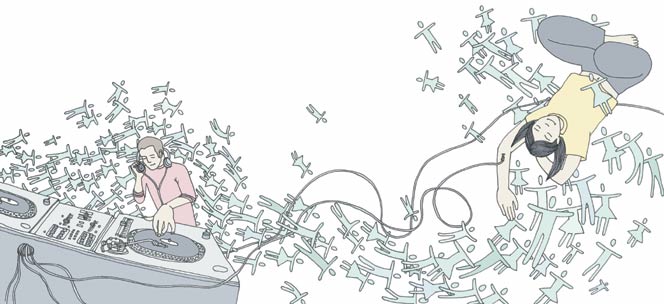
Soma FM: currently my favorite radio station . Lot's of good ambient, good variety. Definitely thumbs up. Try "Cliquehop" and "Beat Blender."
(the bit-rate on campus usually sucks, but it's worth a try, I promise. You can access Soma on iTunes as well.)
Radio Io: one of the more consistent radio stations. good selections of imports - give it a try. (the commercials are bad ... just turn down the dial)
ioBeat - house music, ambient, etc. (usually better at night)
ioEdge - also very good. indie rock, new music, etc.
Any recommendations?
(the bit-rate on campus usually sucks, but it's worth a try, I promise. You can access Soma on iTunes as well.)
Radio Io: one of the more consistent radio stations. good selections of imports - give it a try. (the commercials are bad ... just turn down the dial)
ioBeat - house music, ambient, etc. (usually better at night)
ioEdge - also very good. indie rock, new music, etc.
Any recommendations?






Film 101: the Cinema is a Black Mass
Some poison-enveloped candy, via literary critic Walter Benjamin,
"Art in the Age of Mechanical Reproduction:"
Thanks to the camera, therefore, the individual perceptions of the psychotic or the dreamer can be appropriated by collective perception. The ancient truth expressed by Heraclitus, that those who awake have a world in common while each sleeper has a world of his own has been invalidated by film – and less by depicting the dream world itself than by creating figures of collective dream such as the globe-encircling Mickey Mouse.
The representation of human beings by means of an apparatus has made possible a highly productive use of the human being’s self-alienation … Not only does the cult of the movie star which it fosters preserve that magic of the personality which has long been no more than the putrid magic of its own commodity character, but its counterpart, the cult of the audience, reinforces the corruption by which fascism is seeking to supplant the class consciousness of the masses.
All this in order to distort and corrupt the original and justified interest of the masses in film – an interest in understanding themselves and therefore their class. Thus, the same is true of film capital in particular as of fascism in general: a compelling urge toward new social opportunities is being clandestinely exploited in the interests of a property-owning minority.
Working on my Modern Art final as well as my Aesthetics paper, Benjamin and Deleuze in-hand. Seriously though, Benjamin is an incredibly lucid thinker - beautiful and dead-on-target with his assessments of politics, art, and the commercial age. He died in 1940 - and he achieved so much. I'm amazed.
"Art in the Age of Mechanical Reproduction:"
Thanks to the camera, therefore, the individual perceptions of the psychotic or the dreamer can be appropriated by collective perception. The ancient truth expressed by Heraclitus, that those who awake have a world in common while each sleeper has a world of his own has been invalidated by film – and less by depicting the dream world itself than by creating figures of collective dream such as the globe-encircling Mickey Mouse.
The representation of human beings by means of an apparatus has made possible a highly productive use of the human being’s self-alienation … Not only does the cult of the movie star which it fosters preserve that magic of the personality which has long been no more than the putrid magic of its own commodity character, but its counterpart, the cult of the audience, reinforces the corruption by which fascism is seeking to supplant the class consciousness of the masses.
All this in order to distort and corrupt the original and justified interest of the masses in film – an interest in understanding themselves and therefore their class. Thus, the same is true of film capital in particular as of fascism in general: a compelling urge toward new social opportunities is being clandestinely exploited in the interests of a property-owning minority.
Working on my Modern Art final as well as my Aesthetics paper, Benjamin and Deleuze in-hand. Seriously though, Benjamin is an incredibly lucid thinker - beautiful and dead-on-target with his assessments of politics, art, and the commercial age. He died in 1940 - and he achieved so much. I'm amazed.
Subscribe to:
Posts (Atom)


